Let us take minute to rewind.
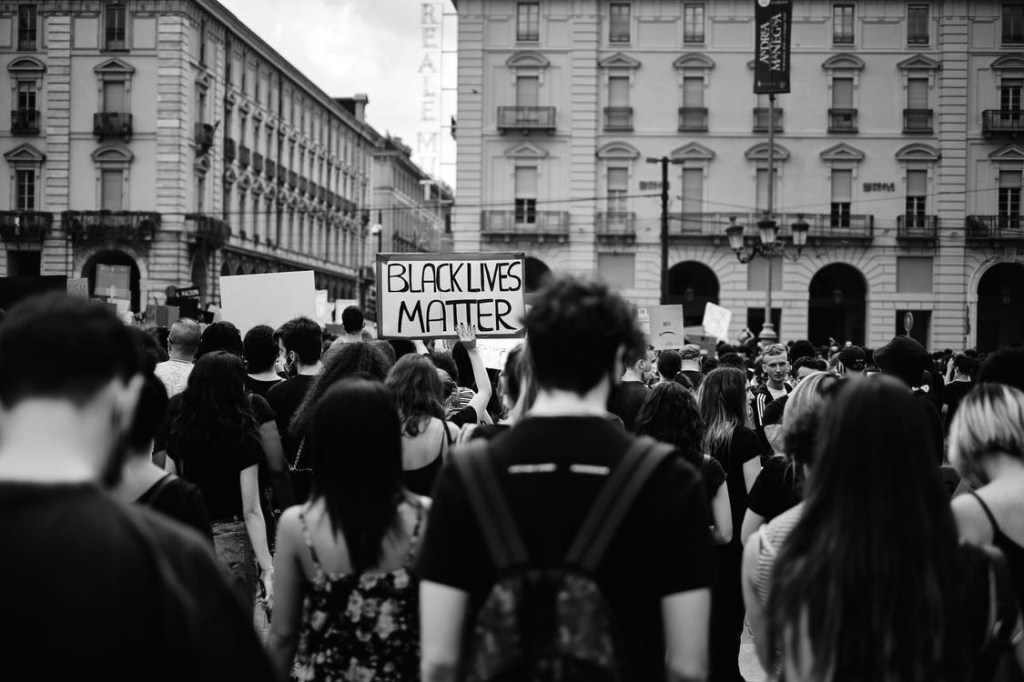
This is only my second week into blogging about culture and identity, and last week we witnessed the unnecessary death of George Floyd – a black American citizen who was murdered by a white policeman in Minneapolis. I won’t describe the awful details of the video that captures the last minutes of Mr Floyd’s life, but we can see from the footage, which was filmed from a bystander, that Mr Floyd groaned multiple times, “I can’t breathe.” It was horrific. However, I want to focus on something more important in this blog, something that will hopefully increase our knowledge and help move us forward. This isn’t just one loss of life; this is a repetition of cases, such as Ahmaud Arbery, Philando Castile, Sandra Bland, Eric Garner, Breonna Taylor and many more. Most importantly, this is another opportunity to speak, rather than stay quiet. This event hasn’t just caused grieving, but has also caught the attention of churches, organisations and people of all different colours, causing them to stand together and showing us how incredibly important action is across all ethnic groups. Don’t let there be two tragedies. The first tragedy has already happened, but the second tragedy would be to remain silent. No law can change the way we look at another ethnic group. This is more than what we write on paper and what we pass through governments. This involves everyone taking time to understand themselves and each other better.
Our ethnic heritage shapes our thoughts, fears, beliefs and perspectives on the world, whether we are aware or not. This, as a result, creates a unique world view for every single individual. I was born in Hong Kong to a British father and a Peruvian mother. When my mother moved to the UK and met my father, she brought some of her culture, beliefs and perspectives. Similarly, when my parents got married and moved to Hong Kong, they both took part of their identity with them. Which means I was a British-Peruvian baby being raised in Hong Kong … confusing, but a beautiful cultural mix at the same time. My mother tells me that there were times, as a toddler, I would forget my English and only speak in Spanish to my father. When we got back to England, I refused to wear clothes because, in Hong Kong, as a result of the humidity, I got used to running around in just my nappy! The fortunate thing about my upbringing was that there was a safe space for me to be myself.
What am I trying to say? When we migrate to other countries, we will always carry a bit of our own identity. However, when Africans were first brought over to America in the early sixteenth century, they were brought as slaves, and were seen as sub-human, their identity supressed from the very beginning. African Americans went on to endure years of slavery, lynching and segregation. Although slavery may have been a long time ago, the Jim Crow segregation laws were only abolished 56 years ago. This means that there are still people who are alive today who were victims during those years of suppression and segregation. This means that the dehumanisation of African Americans went on for the best part of five centuries. There are many examples of dehumanisation throughout history: the comparison of ethnicities to animals; newspaper cartoon drawings; book covers; TV shows; etc. In fact, America used to record black people in censuses as only being three-fifths of a human. Very quickly, dehumanisation of black people became a part of everyday life – not just for one generation, but for many.
Let us take the unfortunate example of a young girl, sexually abused throughout her childhood by an older man. What psychological impact would this have on her later in life? Might she fear men? Might she feel shame? Might she find it harder to integrate socially? A long history of suppression in America is bound to have parallel psychological effects on the future generations of African Americans, and for all black people throughout the world, whose ancestors – or even they themselves – have experienced, witnessed or heard of similar traumas. This psychological impact is still present today; so much so that my boyfriend, who is a black British male, was still told as a child that he will be viewed differently because of the colour of his skin. The sad thing is: I know he is one of many 21st-century young black men and women who were told the same during childhood.
I want to now link this together and talk about it from the perspective of people whose ancestors haven’t experienced pain and trauma like this. In my last blog, I touched on how children can learn many languages simultaneously at such a young age. I regularly say to people that I acquired the Spanish language when I was growing up because my mother always spoke it to me in the house. Before I started learning Spanish in secondary school, I knew how to use irregular verbs and structure grammatically complex sentences. I didn’t know how I was doing it, but I was just able to. In the same way, behaviours, thought processes, beliefs and ideas are constantly being learnt and developed throughout our childhood. If children can acquire language without even having to sit a class, I wonder how many other things we have acquired in our childhood that we haven’t taken a moment to question or study. What if these thoughts are never questioned, generation after generation? What if the way in which we view other ethnicities is never given a second thought? And what if our response to the death of George Floyd is silence – not because we intend to, but because we don’t know how to respond?
I always say that it is possible to understand each other better. This won’t come from you just scrolling through Instagram or watching Netflix series or YouTube videos, but it will involve taking the time to talk to people, understanding their perspectives and even unlearning some of the things we have been taught from childhood. I admit that even I had to unlearn something. I was so horrified by the George Floyd video I had seen on Instagram that morning that, when my boyfriend showed me, I said, “I have no words.” He, of course, understood that I was deeply affected and couldn’t express my feelings at that time. However, I then thought about it for an hour and went back to his room and said, “It was wrong what I said before; I do have words, I have a blog now!” What was telling me that I didn’t have words? Was it society? Was it my fear of saying something wrong? Was it even the fact that I wasn’t black? Whatever it was, I unlearnt it quickly and started using my words. You may not have a blog, but can I encourage you today just as I encouraged myself: you do have words!
Lastly, I want to say that the word ‘love’ is a verb, an action word – true love is not just words, but mostly action. The Bible says in John 15:13, “There is no greater love than to lay down one’s life for one’s friends.” (NLT) Let us start truly loving our fellow brothers and sisters from around the world in order to break the silence during times of injustice. Let us reach out and begin to understand each other better.
Author: Laura McBride Galarza
Editor: Melissa Bond

 Kingdom Citizen
Leave a comment