“You look down and realise we’re just humans on a planet and any of these differences and lines in the sand are drawn by us, and they are certainly not worth fighting over.” – NASA Astronaut, Colonel Anne McClain
Understanding our shared biological origins is crucial, but recognising our differences is equally important. I argue we need a more constructive view of human differences. Historically, these differences have been viewed through the lens of scientific racism. This perspective separated humans into distinct species. This outdated view still persists in explicit and implicit ways today. We must acknowledge human differences in a way that fosters connection rather than division. Instead, I believe we should recognise our beautiful diversity through the unique individual journeys that stem from our shared origins. Anthropologist, Ashley Montagu (1962) suggested, exploring a person’s ethnicity should be a journey of inquiry and discovery, one that leaves space for deeper understanding. Research shows that each person’s ancestral journey has been shaped by different experiences, challenges and successes. This article explores how embracing this narrative fosters a more inclusive view of human diversity. It highlights both our shared humanity and the unique ancestral journeys that shape our modern day ethnic identities.
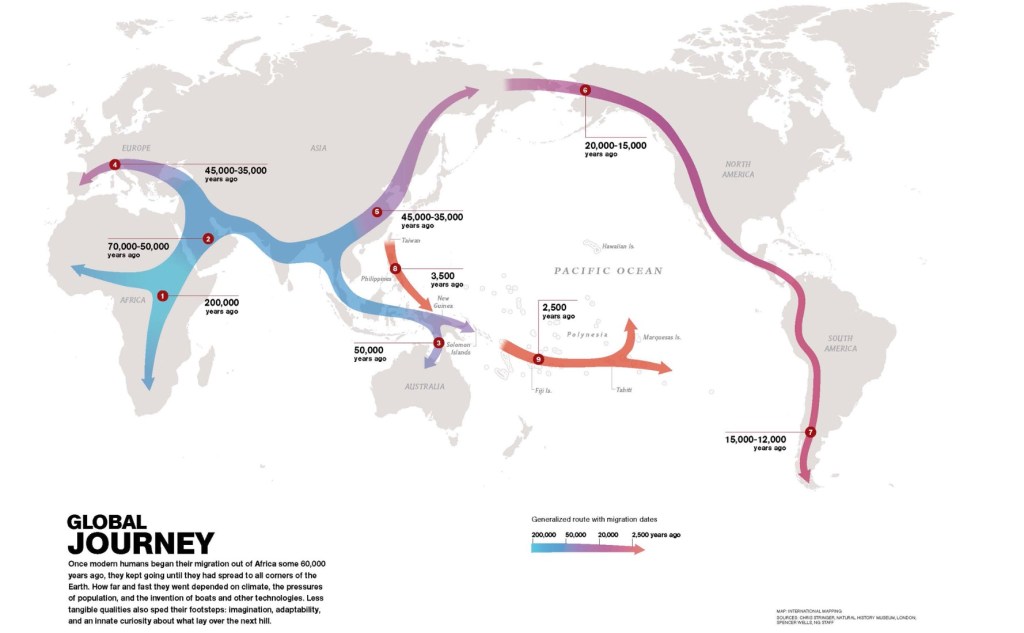
Relethford and Bolnick’s (2018) research demonstrates that human genetic diversity arises from historical migration patterns, adaptation to local environments and periods of isolation, rather than from biologically distinct origins. Earth’s geology offers further insight. In 1915, Alfred Wegener introduced the concept of Pangaea. It was a supercontinent that gradually split apart through the process of continental drift. This shifting formed the continents we recognise today, enabling human migration across the globe. These migrations played a key role in shaping the genetic and cultural diversity we see today. Research by Dr. Spencer Wells (2002) in The Journey of Man identifies three major waves of human migration that originated from Africa, the ancestral homeland of all humans. These migrations have profoundly influenced the genetic and cultural diversity of modern-day populations.
Wells’ research shows that the first migration wave occurred around 60,000 years ago when humans left Africa, traveling to Southeast Asia and Australasia along the coast. This journey improved their seafaring skills, allowing them to cross large oceans. Their ability to navigate these waters and the isolation that followed helped preserve earliest human traits in one of the world’s oldest cultures, the Aboriginal tribes. Around 40,000 years ago, the second wave took humans from Africa to Europe and Central Asia. As they adapted to colder climates, they developed lighter skin pigmentation for better vitamin D absorption in low sunlight. Wells notes that this migration brought distinct cultural practices, tools and art to the region. The famous Lascaux cave paintings in France, dating back around 17,000 years, depict animals and hunting scenes, suggesting connections to earlier African traditions, showing how migrating humans carried their artistic and cultural practices with them into Europe. Wells also highlights innovations in early Asian cultures, such as bone and antler tools in Siberia and pottery in East Asia over 20,000 years ago.
The third wave of migration, around 15,000 years ago, saw humans move into the Americas via the Bering land bridge, which connected Siberia to Alaska during the last Ice Age. This land bridge allowed people to walk into the continent now known as the Americas, but as the Ice Age ended, the bridge disappeared, isolating the populations in the Americas. This migration significantly shaped both North and South America. Early migrants adapted to a variety of environments, leading to the development of distinct cultures, languages and lifestyles across the continent. Wells highlights that these early populations also utilised sophisticated hunting and gathering techniques, leading to the establishment of various indigenous groups in the region and advanced trade networks. An example from my own ancestry is the Inca civilisation, which emerged in the Andean region and was known for its advanced agriculture and extensive road systems for trade and communication.
Evidence of these migration waves is still reflected in the presence of native peoples who inhabit these regions today, despite the impacts of colonisation. Wells’ research shows that it’s hard to define ethnic groups with clear boundaries, as they aren’t tied to just one place. Instead, ethnicity reflects the bigger story of human migration over three main waves. From Africa to Australasia, then into from Africa into Europe and Central Asia, and finally there are those from Central Asia who crossed the Bering Land Bridge into the Americas. This shows how ethnic classifications have changed over time, shaped by migration and historical events. Differences in appearance, like skin tone, height, hair and eye colour hint at ancestral migration and adaptation to different climates. Since then, we have established more classifications as human micro-evolution has become more defined, shaped by shared social traditions, languages and practices within different groups.
On official government documents asking for my ethnicity, I select ‘Mixed with any other ethnic groups. This acknowledges my mother’s South American roots and my father’s European heritage, half French and half English. I feel that identifying as White-Hispanic best reflects my background, though is not an ethnic classification currently recognised in the UK today. My lighter skin comes from my European ancestry, while ‘Hispanic’ connects me to my mother’s heritage, which includes traits from South America’s indigenous peoples. According to Wells’ research, my ancestors were part of the second and third waves of migration out of Africa. Some moved west through Eurasia into Europe, while others crossed the Bering land bridge into the Americas. I remember first seeing pictures of the native people living in Siberia today, they are the closest ancestors to the native people who crossed the Bering land bridge into the Americas. It gave me goosebumps to see how similar they looked to the indigenous people of Peru. These people played a crucial role in shaping the identity of the populations that inhabit the Americas today. Migration shows how people spread across the world, shaping the nations and societies we know today. This explains the small cultural differences between neighbouring countries, where we often see shared language and customs. With curiosity and an open mind, our ethnicity is a historical story waiting to be explored.
In my next article, I will explore how modern ethnic identity has been shaped by human interaction, particularly through colonisation. Colonisation was fuelled by ignorant ideology that some groups were superior based on skin colour and religious beliefs, justifying the conquest of territories and the oppression of native peoples. This mindset ignores the fact that our diverse appearances and cultures stem from common origins, with all human life originating in Africa. As a result, deep divisions persist, especially in Western societies, where white and black people often experience life differently due to ongoing power imbalances. Sadly, oppression and socially constructed hate still exist today. Therefore, ethnicity reveals two stories: one of a person’s ancestral journey across the globe and another of the challenges they face today due to their ancestors’ history.
Map of human migration
References
Relethford, J. and Bolnick, D.A. (2018) Reflections of our past : how human history is revealed in our genes. Second edition. New York: Westview Press. Available at: https://doi.org/10.4324/9780429469756. (Accessed: 2 October 2024)
Wells, S., 2002. A Journey of Man: A Genetic Odyssey. Princeton University Press, Princeton.
 Kingdom Citizen
Leave a comment